

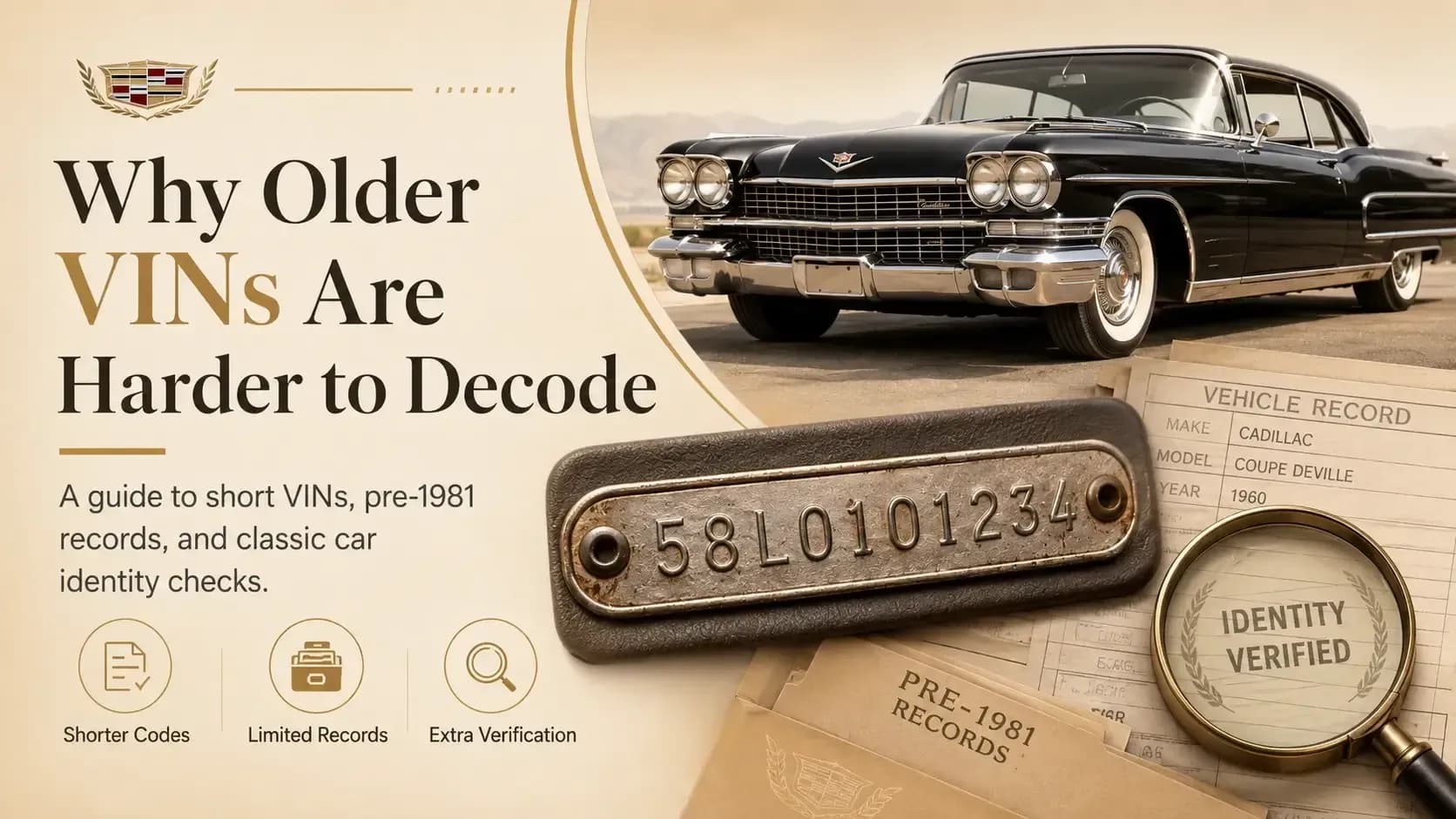
It is difficult to decode VIN numbers for classic cars because of one basic thing: Cars manufactured before the introduction of 17-digit VIN numbers had varying short and model-specific number systems. This makes it possible that a true classic car may be confused by the online VIN decoder.
When verifying an old Cadillac, first check the VIN on the vehicle, compare it to the title and license plate, and then use our Cadillac VIN decoder.
Key Takeaways
- A pre 1981 VIN decoder may not work like a modern VIN decoder because many older VINs were shorter than 17 characters.
- A short VIN does not automatically mean the car is fake, but it does need careful checking.
- Classic buyers should compare the VIN with paperwork, body tags, factory records, and physical inspection clues.
Why Older VINs Don’t Behave Like Modern VINs
Modern VINs feel neat. Seventeen characters. A familiar structure. A lookup tool reads the number and usually returns year, make, model, engine, and basic specs.
Older VINs are not always that tidy.
Before the modern VIN format became common, manufacturers often used their own numbering systems. Some were short. Some focused on production sequence. Some included plant codes or body-series details. Some worked well inside the factory but do not translate cleanly into today’s databases.
That is why a non standardized VIN number can be confusing. It may be valid, but it may not follow the pattern that a modern tool expects.
Short VINs Were Normal
If you are wondering why my VIN number is only 13 digits, the vehicle may simply be older than the 17-character standard. Some classic vehicles used 5, 8, 10, 11, 13, or 14 characters depending on the brand, model year, and vehicle type.
Short does not always mean suspicious. It just means you need a different checking process.
Brand Rules Were Different
Cadillac, Chevrolet, Ford, Dodge, Pontiac, and other brands did not always organize vehicle numbers the same way. One brand might identify body style. Another might include plant information. Another might rely on separate body tags for trim and paint.
So a vintage car VIN decoder needs more than a search box. It needs the right brand and year logic.
Records Were Often Paper-Based
Many older vehicles lived most of their lives before digital records were normal. Titles, dealer paperwork, service receipts, and factory files may have existed on paper only.
That is why a classic car can be real, titled, and running, yet still show very little in a modern lookup.
Why Online VIN Decoders Fail on Old Cars
Online VIN tools are built around patterns. When the VIN does not fit the pattern, the tool may reject it, misread it, or return nothing.
Here are the most common classic car VIN lookup limitations buyers run into.
⚠️ The Tool Expects 17 Character
Many lookup tools are designed for newer vehicles. If you enter a short VIN, the system may treat it as incomplete.
This is one of the most common reasons an old vin number lookup fails.
⚠️ The Record Is Not in the Database
Even when the number is correct, the database may not have a match. Older vehicles may have limited title history, missing registration records, or no linked factory data.
A missing result does not prove the car is fake. It only means that one system does not have the answer.
⚠️ The VIN Was Copied Wrong
Old VIN plates can be worn, painted over, scratched, or hard to read. A seller may copy a character wrong from a title, registration, or auction sheet.
Before assuming the worst, compare the number carefully. If the VIN search fails completely, this guide on why your VIN is not found can help you check the basic causes first.
⚠️ The Paperwork Has Old Mistakes
Classic cars move through estate sales, restorations, auctions, long storage, and state transfers. Somewhere along the way, a clerk may have typed the number wrong.
A tiny paperwork error from decades ago can still show up today. Annoying? Very. But it happens.
How to Decode and Verify a Short Classic VIN
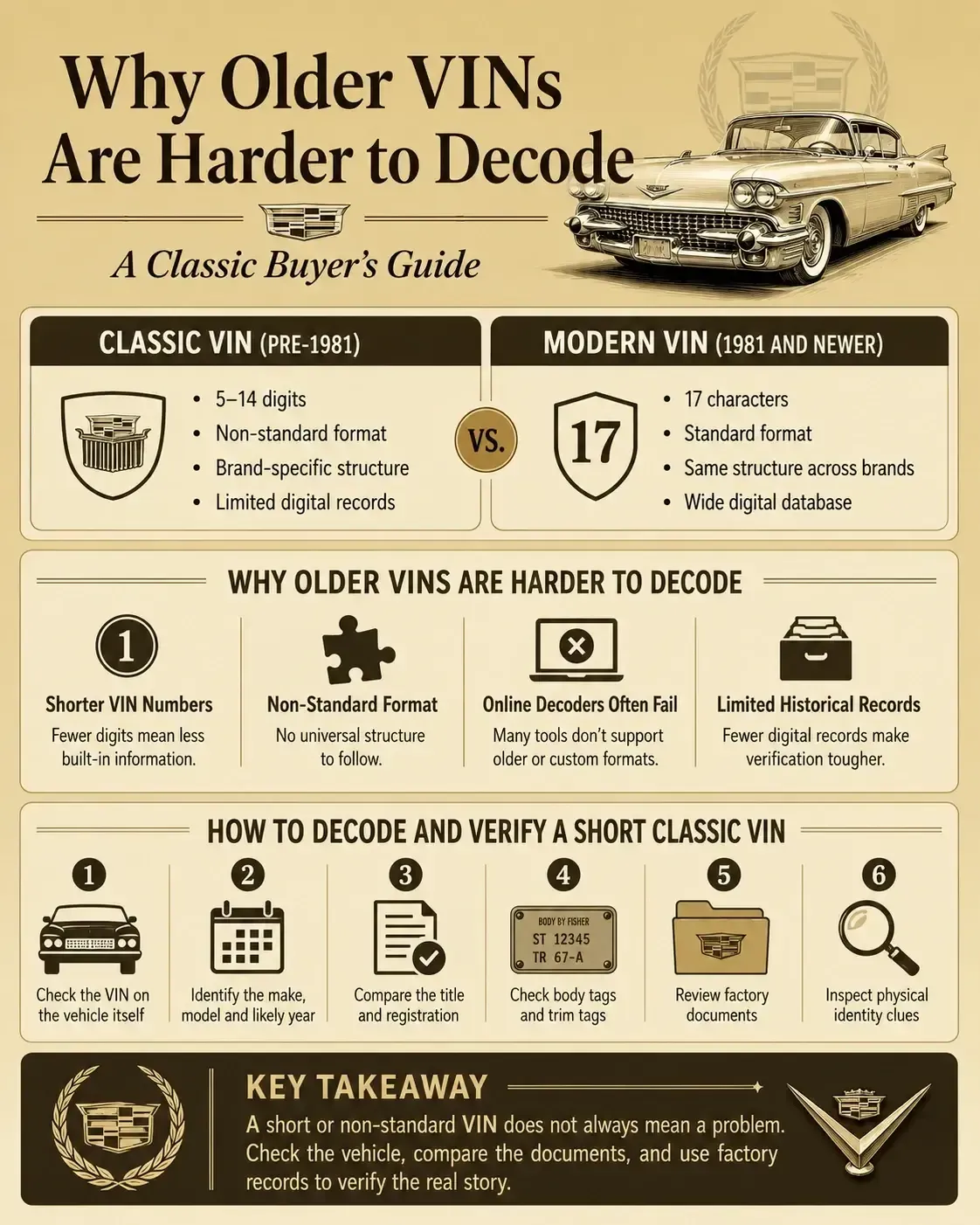
A short VIN should not be checked with one source only. For older vehicles, decoding and verification usually happen together. You read the number, compare it with documents, then confirm the car’s identity through factory tags, physical clues, and records.
Then use this list:
1
Copy the VIN from the vehicle itself
Start with the physical car, not the seller’s listing. Check the VIN plate, stamped number, door area, dash area, firewall, frame location, or brand-specific ID points.
2
Identify the make, model, and likely year
Older VIN meaning depends on the brand and year range. A Cadillac short VIN may not follow the same structure as another classic vehicle.
3
Compare the title and registration
The number on the car should match the paperwork. If there is a mismatch, ask questions before paying.
4
Check body tags and trim tags
Many older vehicles use separate tags for body style, paint, trim, or production details. These can help support the VIN story.
5
Review factory documents
Build sheets, old dealer papers, original sales documents, or factory records can help confirm equipment, color, trim, and production details.
6
Inspect physical identity clues
Look for engine markings, casting numbers, repaint clues, replaced panels, unusual welds, or signs that tags were moved.
How to Check the History of a Pre-1981 Vehicle
Checking an older vehicle’s history takes more legwork than checking a newer car. That does not make it impossible. It just means you should gather evidence from more than one place.
If you are asking how do I check the history of a pre 1981 vehicle, start with the records that are easiest to verify.
Title and Registration Records
Check whether the title is clean, branded, bonded, rebuilt, or missing. Compare old registrations if the seller has them.
Service and Ownership Papers
Old service receipts, insurance cards, owner manuals, dealer papers, and maintenance notes can help build a timeline.
Factory Records
Build sheets, trim tags, body plates, and original sales documents may help confirm how the vehicle was originally built.
Auction, Club, and Enthusiast Records
Classic car clubs, old auction listings, restoration folders, and owner forums can sometimes help trace a vehicle’s past.
Physical Inspection
The car itself still speaks. Paint layers, weld marks, panel fit, engine stamps, and interior trim can reveal changes that paperwork misses.
Professional Appraisal
For a higher-value classic, a specialist inspection or appraisal can be worth the cost. Not every old car needs it, but rare cars do.
Where Factory Documents Can Help
Older VINs are harder because they often leave missing context. Factory documents can help fill that gap.
A build sheet may show factory configuration, production details, engine, transmission, paint, trim, packages, or equipment when available. A window sticker may show original sales-label data such as MSRP, listed equipment, colors, warranty, and fuel economy when available.
For older Cadillac vehicles, a Cadillac build sheet may help verify factory build details when available.
This matters most when a seller claims the vehicle is original, rare, correctly restored, or built with specific equipment. A claim is nice. A record is better.
Final Thought: Old VINs Need More Patience
Why older VINs are harder to decode is not a mystery once you understand the history. Older cars were built under different numbering systems, and many records were never created for modern online tools.
So do not panic if a pre 1981 VIN decoder gives you little or no result. A short VIN may still be real. A missing online record may still belong to a legitimate car.
But do not guess either.
Check the car. Check the documents. Look for factory records. Ask better questions. If the story gets clearer with each step, good. If it gets stranger, slow down.
Classic cars are allowed to have character. Their paperwork should still make sense.
Frequently Asked Questions
Why do online VIN decoders not work for antique cars?
Online VIN decoders don't work for old cars as they need a new 17-digit VIN code. Antique cars may have a different or old code that the decoder doesn't recognize.
Why is my VIN only 13 digits?
A 13-digit VIN may indicate that your vehicle is old because manufacturers started using a new 17-digit code recently. Many older vehicles had shorter identification codes.
Is it possible that the VIN of pre-1981 vehicle is less than 17 digits?
Yes, as it is the case of many old vehicles; however, the exact code can differ depending on the vehicle model and the manufacturer.
How can I find the history of the pre-1981 vehicle?
Look through the vehicle title, registration record, repair receipts, factory records, insurance cards, auction record, car club information, and physical characteristics of the car.
How to prove the identity of an antique car with no regular VIN?
Check the VIN or serial number against the title, body tag, trim tag, engine stamping, factory records, and physical condition. For more valuable cars, consult a professional classic car inspector.
How to verify classic car identity without a standard VIN?
Compare the VIN or stamped number with the title, body tag, trim tag, engine markings, factory records, and physical condition. If the car is valuable, ask a classic vehicle expert to inspect it.
Can a classic car VIN lookup show factory equipment?
Sometimes, but not always. A classic car VIN lookup may show basic identity details, while factory equipment may require a build sheet, trim tag, window sticker, or manufacturer record.