
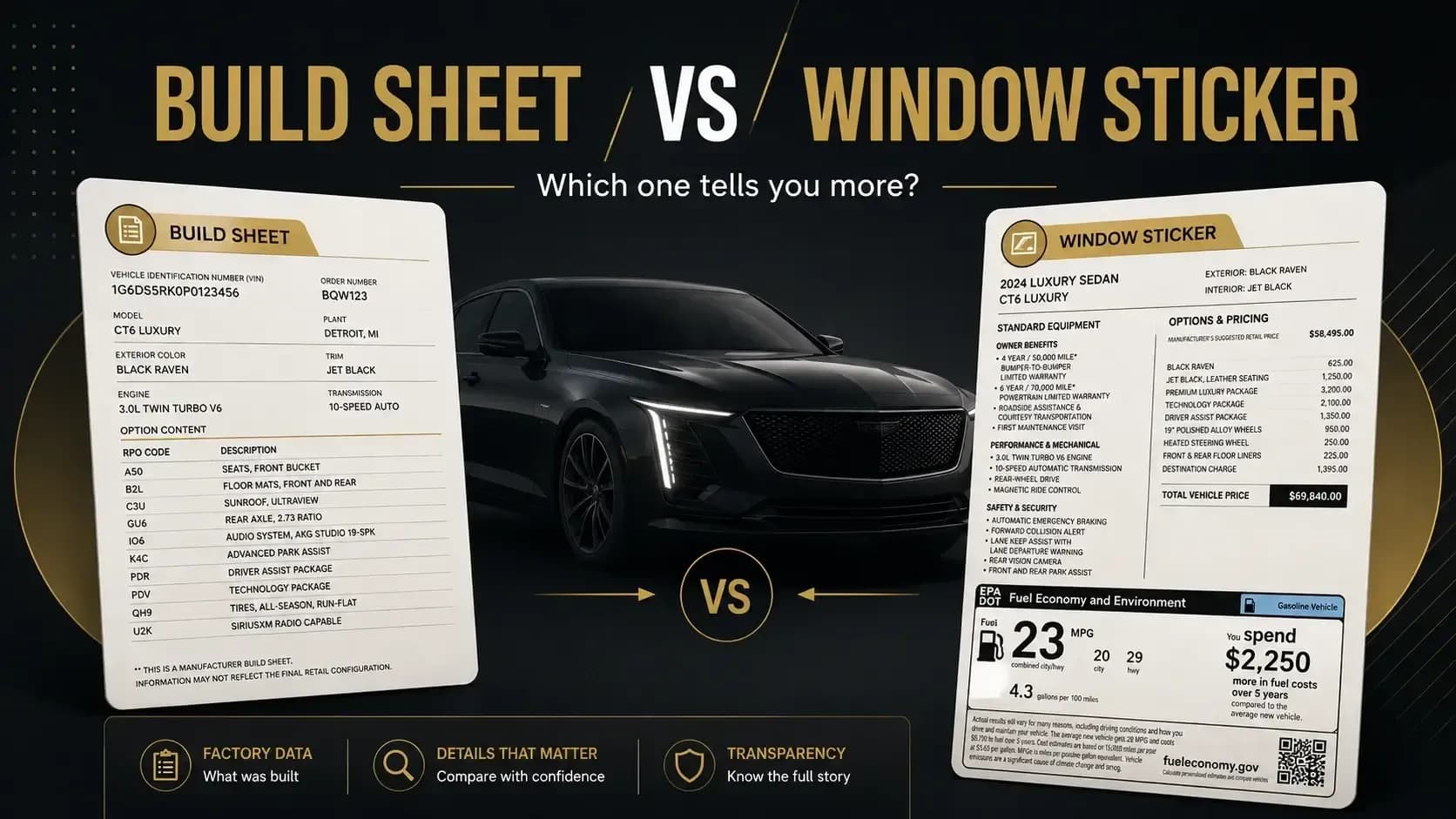
A build sheet vs window sticker comparison comes down to purpose. A build sheet focuses on how a vehicle was built at the factory. A window sticker shows how the vehicle was labeled, priced, and presented for sale when new.
For Cadillac buyers, both can be useful. A Cadillac build sheet may help verify factory build details, while a window sticker can show original MSRP, options, warranty, fuel economy, and sales-label information.
Key Takeaways
- A build sheet is mainly about factory build configuration and production details.
- A window sticker is mainly about original pricing, equipment, warranty, fuel economy, and buyer-facing information.
- Used buyers, restorers, and car flippers can use both to verify what the vehicle originally was.
Start with the Purpose of Each Document
Before comparing line by line, it helps to know why these documents exist. They are related, but they were not created for the same person.
A build sheet was closer to the production side of the car. It helped identify how the vehicle should be built, equipped, trimmed, painted, and assembled. Think of it like the recipe card behind the car.
A window sticker was made for the sales side. It helped the buyer see the price, features, warranty, fuel economy, and equipment when the vehicle was new.
That is the real difference between build sheets and window stickers. One explains the build. The other explains the sale.
And honestly, used-car buyers need both perspectives. A car can look great in photos, but the paperwork tells you whether the story has solid bones.
What Is a Build Sheet?
When you ask me what a build sheet is, consider it as a factory-specific document that records the configuration of a particular vehicle. There are chances that it will feature a build code, option packages, paint, interior trim, driveline info, engine specs, among other things.
It comes in handy, particularly if you have an old car, restored car, modified car, or rare car. It gives you a more technical view of the vehicle’s original setup.
Here are common types of information a build sheet may help confirm.
Factory Configuration
A build sheet may show the original model, body style, trim, drivetrain, engine, transmission, and mechanical setup tied to the vehicle.
Paint and Trim Details
It may help confirm original exterior color, interior color, seat material, trim combination, or related build codes.
Option and Package Data
A build sheet may show factory option codes, equipment groups, packages, and other build-level details that explain how the vehicle was assembled.
Production Information
Depending on the vehicle and record source, it may include plant information, production sequence, or build-related identifiers.
So, the build sheet is not really written like a sales brochure. It can feel dry. But for the right buyer, that dry detail is gold.
What a Window Sticker Shows
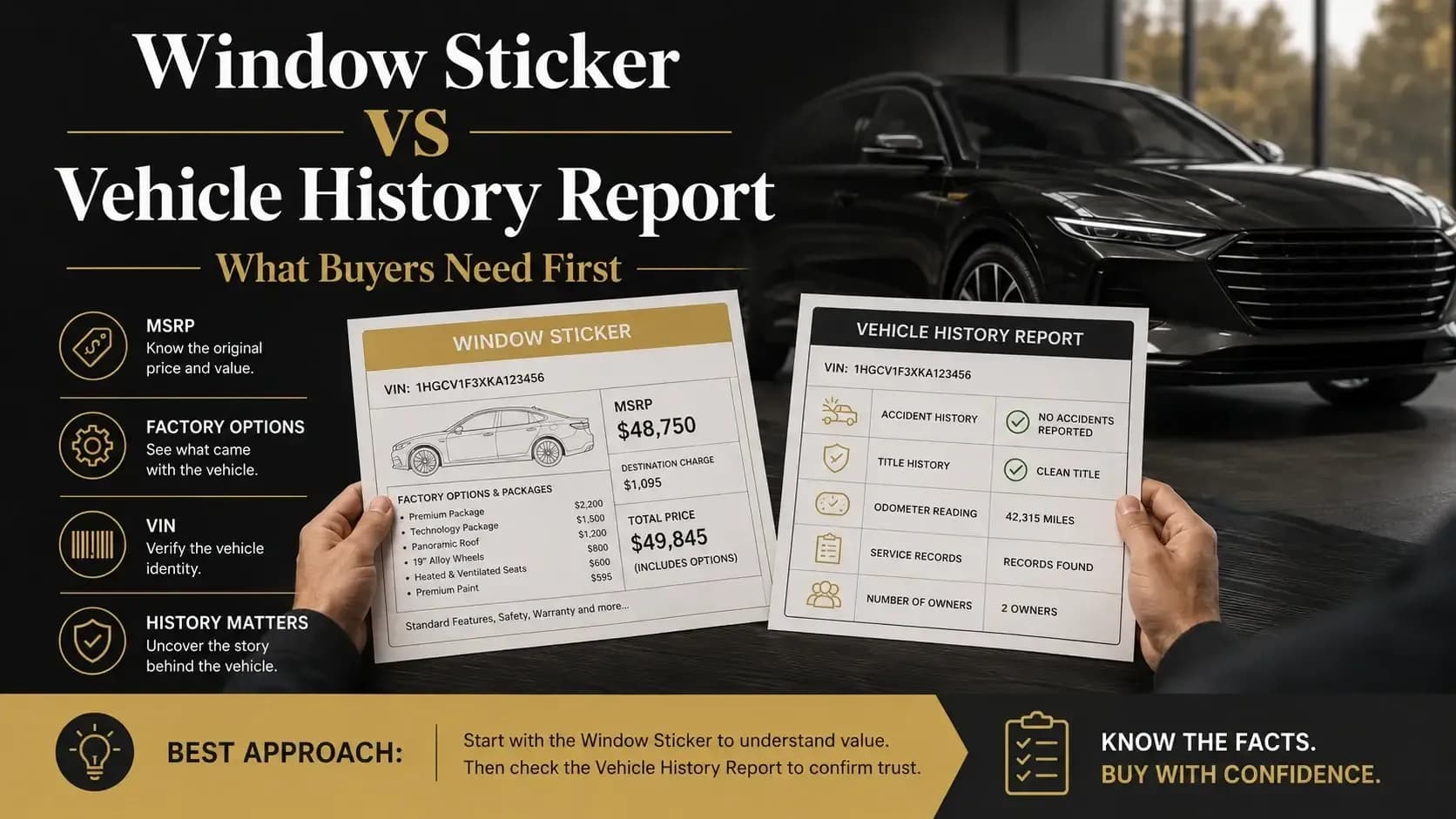
Now let’s look at the window sticker. A window sticker is easier for most buyers to read because it was designed to explain the vehicle to a customer.
A window sticker usually shows original pricing, standard equipment, optional equipment, warranty terms, fuel economy, safety rating sections, and vehicle identity details. If you want a deeper reading guide, this article on how to read a window sticker explains the main sections in a simple way.
A window sticker may include details like these.
VIN and Vehicle Description
The sticker may show the VIN, year, make, model, trim, body style, engine, transmission, and drivetrain.
MSRP and Total Vehicle Price
It may show base MSRP, option pricing, package pricing, destination or shipping charge, and total vehicle price.
VIN and VehicleStandard and Optional EquipmentDescription
The sticker separates standard features from added packages or listed accessories. This helps buyers check claims like “fully loaded” or “premium package.”
Warranty and Fuel Economy
It may show original warranty coverage and fuel economy estimates, such as city, highway, and combined MPG.
For example, a 2016 Cadillac CTS Sedan window sticker can show an MSRP of $53,285, a total vehicle price of $60,335, Radiant Silver Metallic exterior, Jet Black leather seating surfaces, a 2.0L Turbo I4 engine, all-wheel drive, V-Sport Package, Black Chrome Package, warranty terms, and fuel economy data.
That is a lot more useful than a seller saying, “It has nice options.”
Build Sheet vs Window Sticker: The Quick Comparison
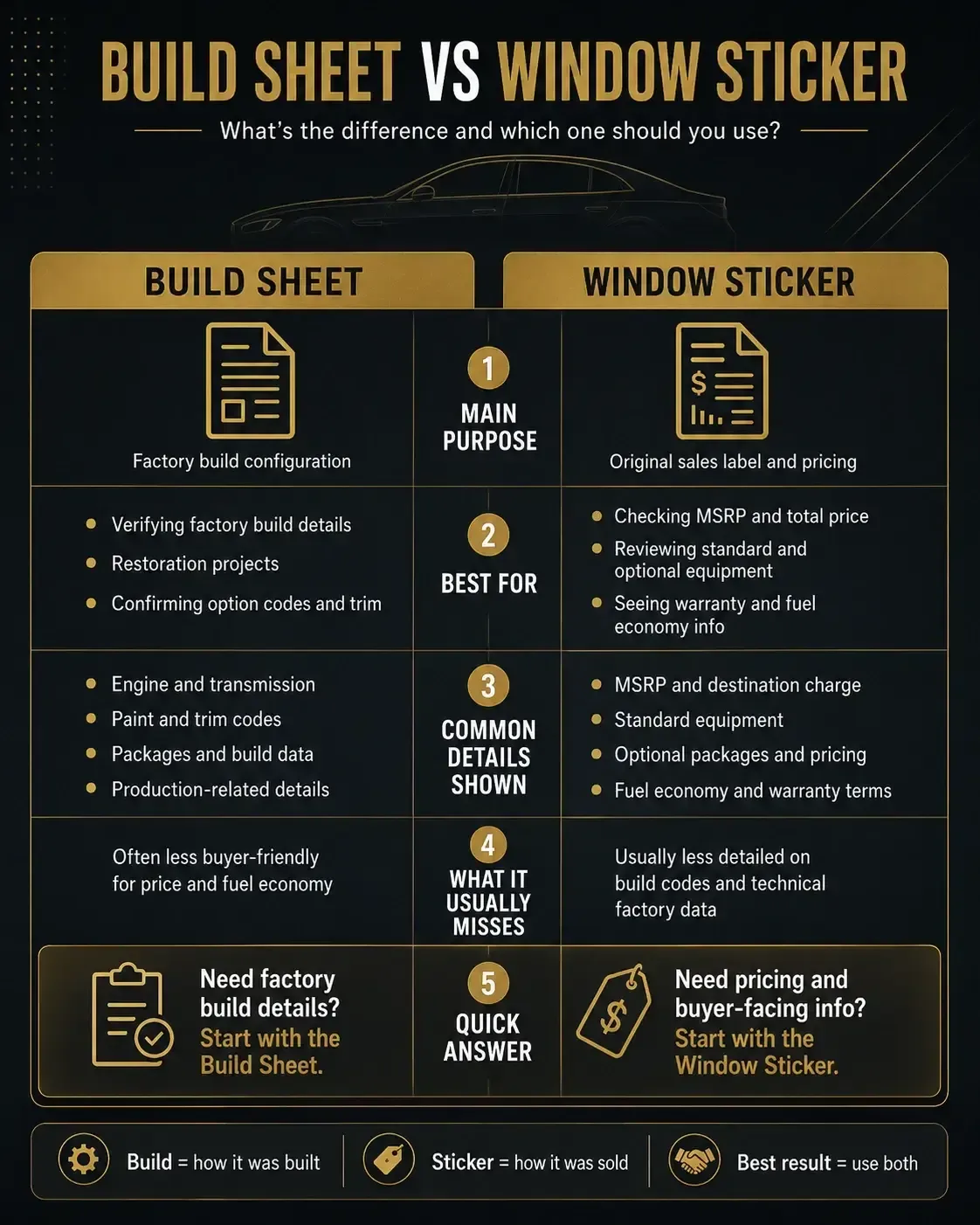
At this point, the difference becomes clearer. The vehicle build sheet vs window sticker question is not about which one is “better” for every buyer. It is about which one answers your question.
| Description | Build Sheet | Window Sticker |
|---|---|---|
| Factory build configuration | Stronger | Sometimes shown in simpler form |
| Build codes or option codes | Often helpful | Usually less code-focused |
| Original MSRP | Not always | Yes, when available |
| Package pricing | Not always | Yes, when available |
| Standard equipment | May be shown | Yes |
| Paint and trim details | Often useful | Often shown clearly |
| Warranty terms | Not usually the main focus | Yes, when available |
| Fuel economy | Not usually | Yes, when available |
| Safety rating sections | Not usually | Yes, when available |
| Buyer-friendly layout | Less friendly | More friendly |
← Scroll horizontally to see more →
So if your question is, “How was this car built?” The build sheet may help more.
If your question is, “What did this car show to buyers when new?” The window sticker is usually easier to use.
When a Build Sheet Helps More
A build sheet becomes more useful when the vehicle’s original configuration matters more than the sales label. That often happens with restorations, classic vehicles, rare trims, and modified cars.
Here are situations where a build sheet can be the better document.
Classic or Older Vehicles
Older vehicles may not have modern sticker data available. A build sheet or build record may help confirm original paint, trim, engine, drivetrain, and option groups.
Restoration Projects
If you are restoring a car, small details matter. Paint, interior trim, factory equipment, and option codes can affect originality.
Possible Engine or Drivetrain Changes
A build sheet may help confirm what the vehicle originally came with before swaps, upgrades, or repairs.
Rare Package Verification
When a seller claims the car has a rare package, a build-focused document may help support or challenge that claim.
This is where how to get the original build sheet by VIN becomes a useful question. The answer depends on the vehicle, model year, brand, and available records. Some data is easy to find. Some take more digging.
When a Window Sticker Helps More
A window sticker is usually better when your main concern is buying, pricing, comparing, or checking seller claims. It is more readable, and it speaks the language used-car buyers care about.
Here are situations where a window sticker may be more useful.
You Want Original MSRP
If you want to understand what the vehicle cost when new, the window sticker is usually the better source.
You Need Package Pricing
A window sticker can show how options and packages affected total vehicle price, which helps with pricing conversations.
You Want Buyer-Friendly Equipment Details
A sticker often explains standard equipment and added features in a clearer way than build codes alone.
You Want Warranty and Fuel Economy
Warranty terms and fuel economy estimates are usually window-sticker territory, not build-sheet territory.
If you are asking how to get the original window sticker, the usual path is to use the VIN and a window sticker lookup when data is available. For Cadillac vehicles, the Cadillac window sticker can help confirm original sales-label details.
Why Buyers Often Need Both
Here’s the mild contradiction: you may not always need both documents, but when you are spending serious money, both can be worth checking.
A window sticker may show original price and package names. A build sheet may show deeper factory configuration. Together, they can help you compare the seller’s claim with the vehicle’s original identity.
This matters for used Cadillac buyers, car flippers, and enthusiasts because value can hide in details. The engine, trim, color, package group, warranty terms, and original MSRP can all change how a vehicle should be judged.
If you are comparing paperwork before buying, this used-car guide on what to check before buying a used car can help you connect factory data with inspection, title, mileage, and condition checks.
How to Read a Build Sheet vs Window Sticker
How to read a build sheet vs window sticker depends on what you are trying to confirm. Do not read them the same way. They speak different languages.
For a window sticker, start with the visible buyer details: VIN, model, MSRP, total price, standard equipment, options, warranty, and fuel economy.
For a build sheet, start with configuration details: model codes, equipment groups, drivetrain, paint, trim, engine, transmission, axle, plant data, and option codes when shown.
Use this simple approach:
- Read the window sticker first if you want the buyer-facing story.
- Read the build sheet first if you want the factory build story.
- Compare both if the vehicle is expensive, rare, restored, or modified.
- Check the actual car because documents can’t replace inspection.
That last point matters. Paperwork is powerful, but the vehicle still gets a vote.
What Each Document Can Miss
No document is perfect. This is where buyers sometimes get too confident.
A window sticker may not show every technical build code. It may not explain deeper production details. It may not show later changes, repairs, or modifications.
A build sheet may not show original MSRP, fuel economy, warranty, destination charge, or buyer-facing safety sections. It may also be harder to read if it uses codes or compact factory language.
Both documents can be limited by data availability, especially on older vehicles.
The safer habit is simple: use the document for what it does well, then verify the car in person.
Final Thought: Pick the Document That Matches the Question
A build sheet vs window sticker comparison is not about choosing one forever. It is about choosing the right one for the job.
If you want original MSRP, package pricing, warranty, fuel economy, and sales-label details, start with the window sticker.
If you want deeper factory configuration, build codes, original equipment groups, or restoration clues, look for the build sheet.
If you are serious about the car, compare both with the VIN, title, history, and physical inspection. A clean story should get clearer as you check it. If every document creates a new question, slow down.
Frequently Asked Questions
What is the difference between a build sheet and a window sticker?
A build sheet focuses on factory build configuration, such as equipment, codes, drivetrain, paint, trim, and production details. A window sticker focuses on original sales-label details, such as MSRP, options, warranty, fuel economy, and standard equipment.
Why do I need a build sheet if I have a window sticker?
You may need a build sheet if you want deeper factory configuration details, option codes, production data, or restoration information that may not appear on a window sticker.
What information is missing from a window sticker compared to a build sheet?
A window sticker may not show detailed build codes, deeper production information, or certain factory configuration details. A build sheet may provide more technical build data when available.
Is a build sheet more accurate than a window sticker?
Not always. A build sheet and window sticker are accurate for different purposes. The build sheet focuses on factory configuration, while the window sticker focuses on buyer-facing pricing and equipment details.
Can I get a build sheet by VIN?
In many cases, you may be able to use the VIN to search for available build sheet or factory build data. Availability depends on the make, model, year, and record source.
Can I get a window sticker by VIN?
Yes. A window sticker lookup can often use the VIN to find original sticker data, including MSRP, factory equipment, options, packages, warranty, and fuel economy when available.