
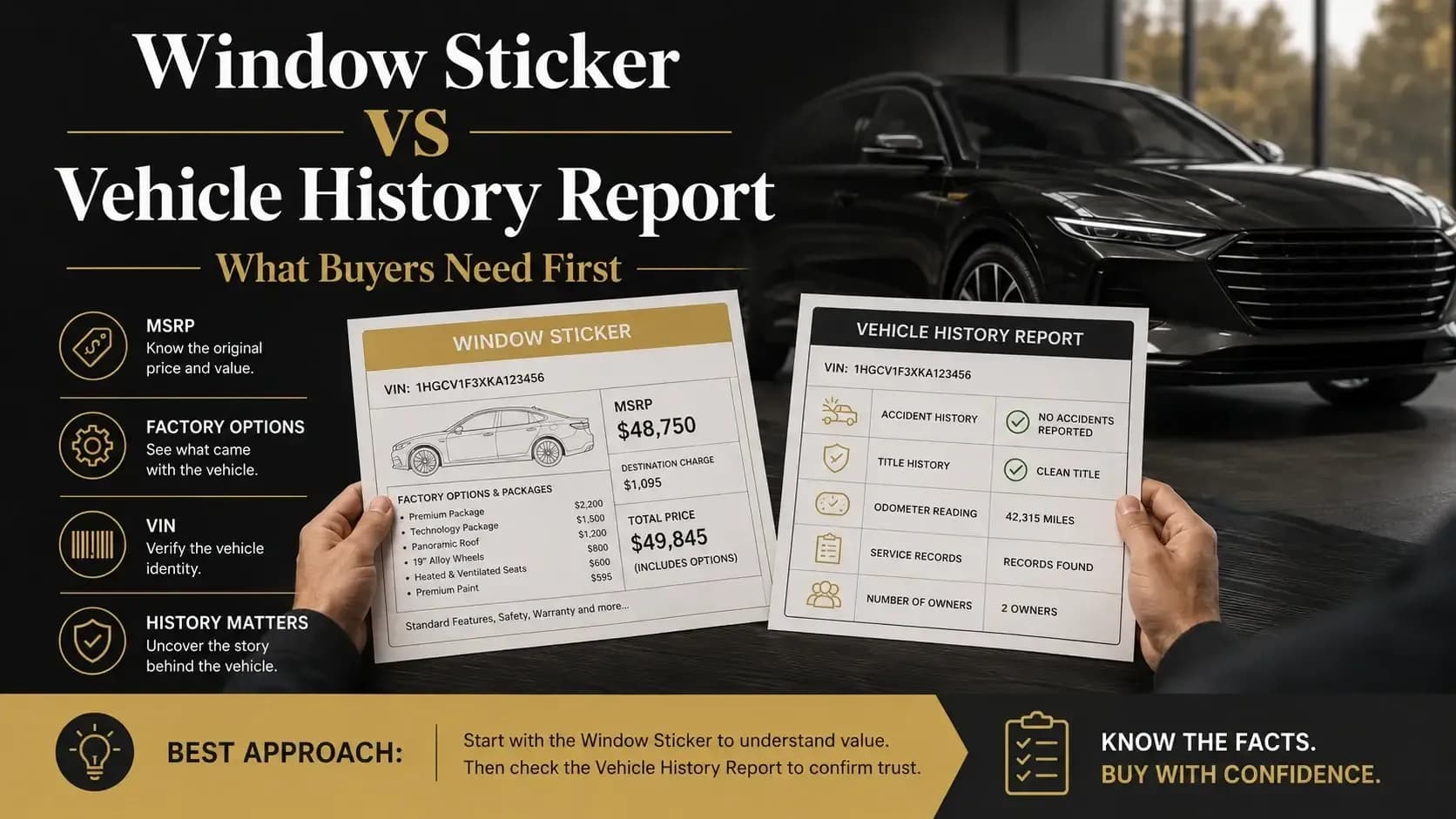
A window sticker vs vehicle history report comparison is simple: a window sticker shows how the car was originally built and priced, while a vehicle history report shows what may have happened after it was sold.
For used Cadillac buyers, an original window sticker lookup can help confirm MSRP, factory equipment, colors, warranty terms, and original details before comparing the car’s history.
Key Takeaways
- A window sticker shows original factory details, including MSRP, options, warranty, fuel economy, and colors.
- A vehicle history report shows recorded events like title records, mileage, ownership, accidents, and possible damage.
- Used car buyers should compare both documents with the actual vehicle before making an offer.
Start with the Role of Each Document
Before comparing the details, it helps to know what each document is built for. They may both use the VIN, but they do not answer the same question.
A window sticker answers: “What was this vehicle when it was new?”
A vehicle history report answers: “What happened to this vehicle after it was sold?”
That’s the real difference between window stickers and vehicle history reports. One looks at the factory side. The other looks at the ownership side.
Think of it like a house. The window sticker is the original floor plan. The history report is the record of repairs, owners, and possible damage over time. You would not buy a house with only one of those. A car is not that different.
What a Window Sticker Shows
The window sticker will show you exactly how the car looked at the time of manufacture. No accident damage or repair work is reflected on it, but it will show what your car was intended to have before modifications or any other work was done on it.
Here is a Car window sticker explained for buyers:
Vehicle Identity
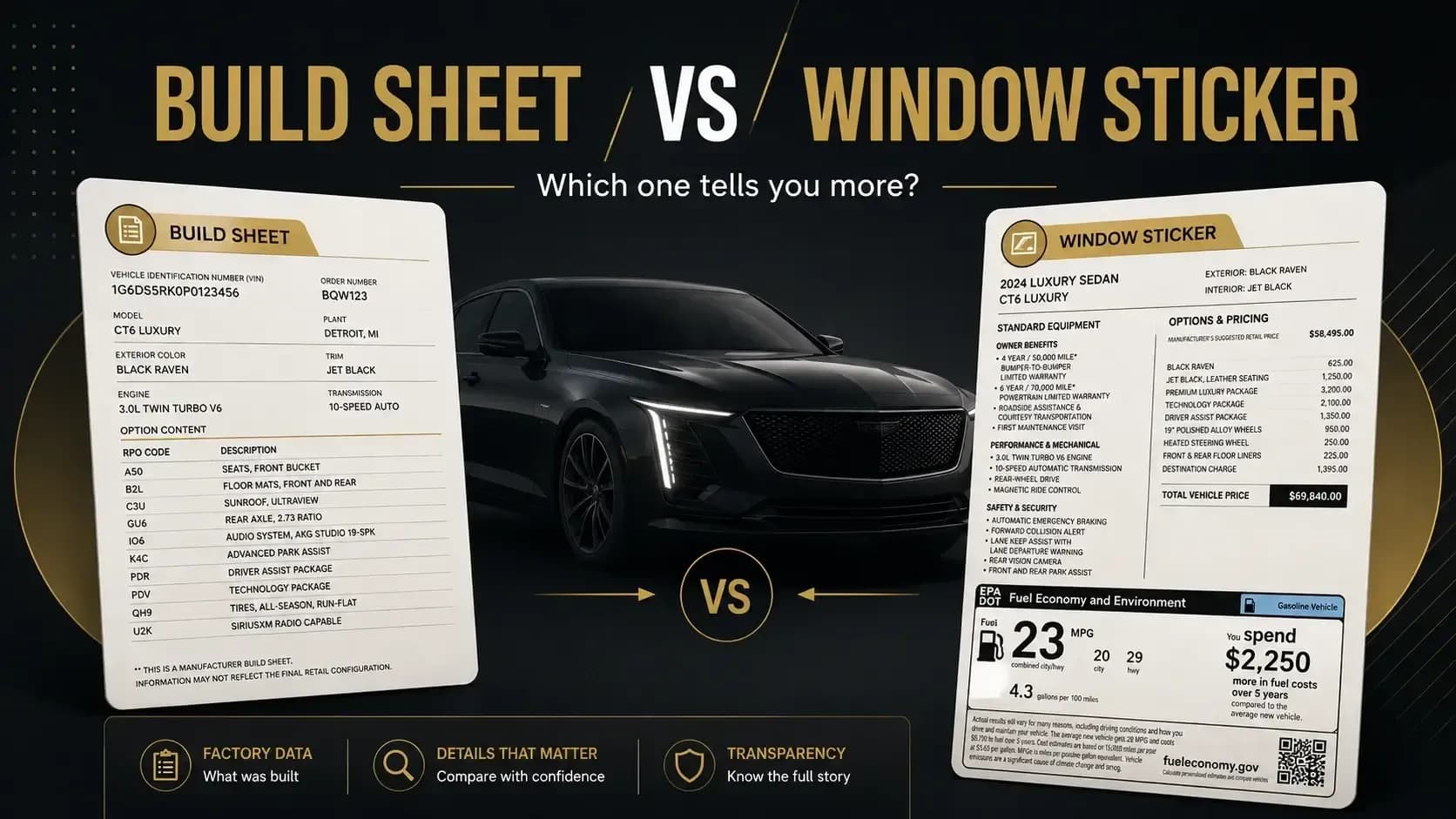
A window sticker may show the VIN, year, make, model, trim, body style, and basic vehicle description. This helps confirm that the listing matches the actual car.
Original MSRP and Total Price
The sticker may show base MSRP, option pricing, package pricing, destination or shipping charge, and total vehicle price. This matters because two similar cars can have very different original prices.
For example, a 2016 Cadillac CTS Sedan sample shows an MSRP of $53,285 and a total vehicle price of $60,335 after listed packages, accessories, and shipping.
Factory Equipment and Packages
A window sticker may show standard equipment, factory options, appearance packages, wheels, infotainment features, safety equipment, and listed accessories.
This is where the sticker helps challenge vague phrases like “fully loaded.” The seller may say it. The sticker can show what was actually listed.
Colors, Warranty, and Fuel Economy
A sticker may show original exterior and interior colors, warranty coverage, fuel economy, and safety rating sections when available.
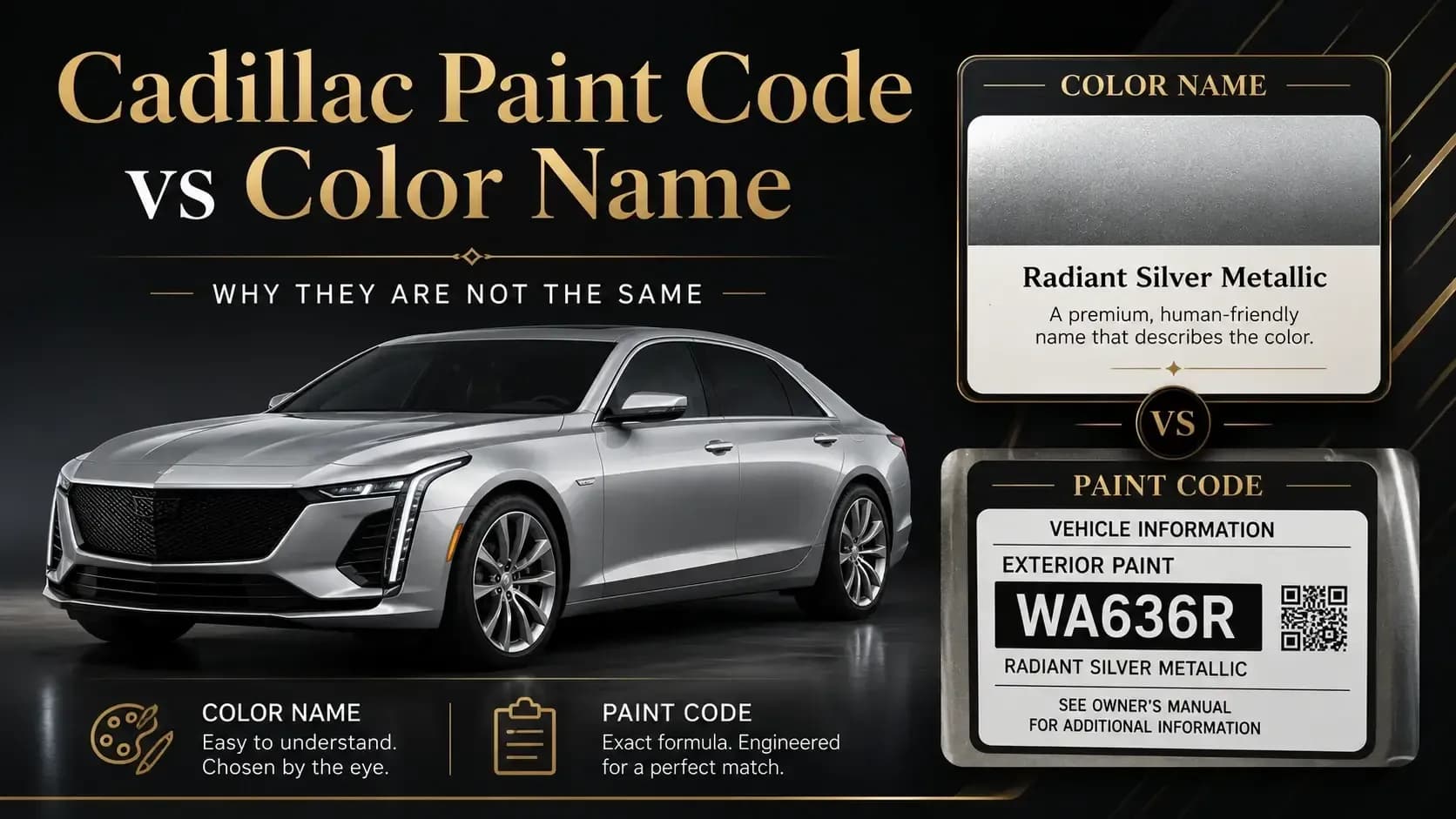
The Cadillac sample, for instance, shows Radiant Silver Metallic exterior, Jet Black leather seating surfaces, basic warranty coverage, powertrain coverage, and fuel economy estimates.
If you want to understand each sticker section more clearly, this guide on how to read a window sticker is a helpful next step.
What a Vehicle History Report Shows
Now let’s move from factory data to road-life data. A vehicle history report is built to show recorded events after the car entered use.
So, what does a vehicle history report show? It depends on the data source, but buyers usually look for these details.
Title and Brand Records
A history report may show whether the vehicle has a clean, salvage, rebuilt, flood, lemon, or branded title record.
This matters because title status can affect insurance, financing, resale value, and buyer confidence.
Accident and Damage Records
A report may show accident records, damage events, airbag deployment, insurance claims, or repair-related records when reported.
That last part matters: when reported. A clean report does not always mean the car was never damaged.
Mileage and Ownership History
Information on mileage could be available at registration, inspection, service, auction, or sale events. Such information will assist buyers to identify potential problems with the mileage.
Ownership history could tell about number of owners, registration location, and time spent in specific locations.
Service, Auction, and Usage Information
Reports might provide information on service appointments, recalls, auction activities, usage as a fleet, rental or sale.
This kind of information will assist to track movements in the lifecycle of the vehicle.
What Information Is on a Window Sticker vs History Report?
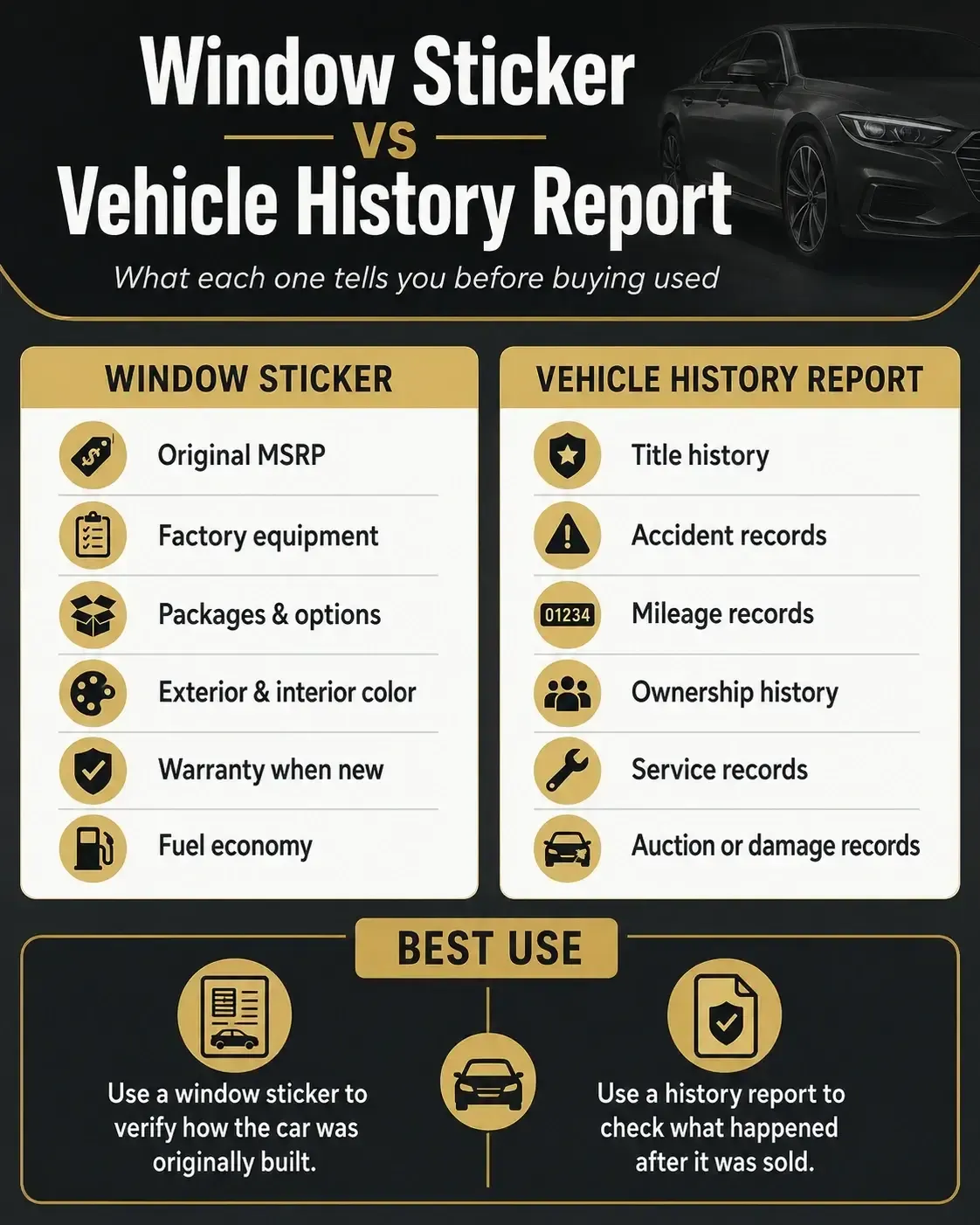
This is where the comparison becomes clear. A window sticker and history report are not competing documents. They are two different lenses.
Use this table when deciding what each one can help confirm.
| Description | Window Sticker | Vehicle History Report |
|---|---|---|
| VIN and vehicle identity | Yes | Yes |
| Original MSRP | Yes | Not usually |
| Factory equipment | Yes | Not usually |
| Factory packages | Yes | Not usually |
| Exterior and interior color | Yes | Sometimes limited |
| Warranty terms when new | Yes | Not usually |
| Fuel economy rating | Yes | Not usually |
| Title history | No | Yes |
| Accident records | No | Yes, when reported |
| Mileage records | No | Yes, when reported |
| Ownership history | No | Yes, when reported |
| Auction or sale events | No | Sometimes |
← Scroll horizontally to see more →
Which One Should You Check First?
The honest answer is: it depends on what you need to verify first. If the listing feels vague, start with the window sticker. If the car’s past feels questionable, start with the history report.
For serious buyers, the better answer is to check both. The order below works well because each step builds on the last.
Verify the VIN First
Start with the VIN on the vehicle. Match it with the listing, title, registration, window sticker, and history report. If the VIN is wrong, every report after that can point you in the wrong direction.
Check the Window Sticker for Factory Details
Use the window sticker to confirm original MSRP, equipment, packages, colors, warranty terms, and fuel economy. This helps you see whether the vehicle matches the seller’s description.
Review the History Report for Recorded Events
Use the history report to check title status, mileage records, accident records, ownership changes, and reported service or auction activity. This helps you understand what may have happened after the vehicle was sold new.
Compare Both with the Actual Car
This is where buyers need to stay sharp. If the sticker shows one color but the car was repainted, ask why. If the history report is clean but panel gaps look strange, keep checking. Documents help. Your eyes still matter.
Where Buyers Often Get Confused
Used car listings can sound clean, polished, and confident. But the wording does not always match the facts. This is where buyers often mix up what each document can prove.
⚠️ A Clean History Report Does Not Mean a Perfect Car
A clean report is a good sign, but it is not a guarantee. Some accidents are never reported. Some repairs are paid out of pocket. Some issues only show up during inspection.
⚠️ A Window Sticker Does Not Show What Happened Later
A window sticker shows original factory details. It does not tell you if the car was crashed, repaired, modified, neglected, or repainted after sale.
⚠️ Factory Features May Have Changed
The sticker may show premium wheels, leather seats, or factory equipment. But a previous owner may have replaced wheels, removed parts, added aftermarket accessories, or changed interior pieces.
⚠️ “Fully Loaded” Needs Proof
“Fully loaded” is a sales phrase, not a factory record. A window sticker can show the packages and options. A history report cannot usually prove that.
How Both Documents Help with Price
This is where the documents become useful during negotiation. Not in a pushy way. Just in a factual way.
The window sticker can support value if the car originally had premium packages, desirable factory equipment, a higher MSRP, or rare color combinations. The history report can adjust value if it shows accidents, title brands, mileage issues, or multiple ownership events.
For example, a Cadillac may have a strong original sticker price because of packages, wheels, appearance upgrades, and factory equipment. That helps explain why it may be priced higher than a similar base model.
But if the history report shows damage or title issues, the asking price should reflect that too.
That is the Difference between window sticker and vehicle history when buying a car. One can explain why the car had value when new. The other can explain what may have affected that value later.
Final Check Before You Make an Offer
Before you make an offer, compare the documents with the car itself. Do not let one clean report carry the whole decision.
Use this quick buyer check:
- VIN matches the vehicle, title, sticker, and report
- Window sticker supports the seller’s equipment claims
- History report does not show major title or mileage concerns
- Paint, interior, and body condition match the story
- Test drive does not reveal obvious mechanical issues
- Asking price makes sense after factory data and history are reviewed
If you want a broader buying process, this used-car guide on what to check before buying a used car can help you review the car beyond documents.
For Cadillac buyers, checking the Cadillac window sticker is a smart way to confirm the factory side of the story before comparing it with history records.
Frequently Asked Questions
What is the difference between a window sticker and a vehicle history report?
A window sticker shows original factory details such as MSRP, equipment, packages, warranty, fuel economy, and colors. A vehicle history report shows recorded events such as title history, accidents, mileage, ownership, and service records.
Does a vehicle history report show factory packages?
Usually, no. A vehicle history report may show title, accident, mileage, ownership, or service records, but it usually does not show full factory packages. A window sticker or build data is better for factory equipment.
What does a vehicle history report show?
A vehicle history report may show title brands, accident records, mileage readings, ownership changes, registration history, service records, auction events, and recall-related data when available.
Can a window sticker show accident history?
No. A window sticker shows original factory and sales-label details. It does not show accidents, title issues, mileage events, or ownership history.
Should I check the window sticker or history report first?
If you want to verify original equipment and pricing, check the window sticker first. If you are worried about title status, accidents, or mileage records, check the history report first. Serious buyers should check both.
Is a clean vehicle history report enough before buying?
No. A clean report helps, but it is not enough. You should also check the window sticker, inspect the car, verify the VIN, review documents, and consider a mechanic inspection.